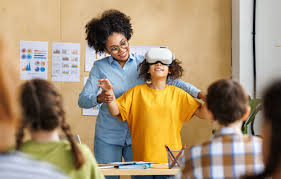
The field of English Language Teaching (ELT) is currently undergoing a profound transformation driven by rapid technological integration, evolving pedagogical research, and a shift toward learner-centric models. As of early 2026, several key trends have emerged that redefine how English is taught and learned globally.
Artificial Intelligence (AI) has transitioned from an experimental novelty to a fundamental infrastructure in the ELT classroom. Rather than replacing human educators, AI is increasingly viewed as a “co-teacher” that augments human capabilities.
The application of game design elements—known as gamification—is a “tried and tested” strategy in 2026 to boost learner engagement.
In response to increasing automation, there is a strong movement to recapture the “human difference” in language education.
Traditional teacher-centered “chalk and talk” methods are being replaced by agile, project-based models.
The rise of digital technology has enabled more educators to set themselves up as “teacherpreneurs,” offering highly specialized and individualized language coaching directly to global markets. This shift is driving demand for advanced certifications and digital literacy skills among teachers to remain competitive in a skills-based economy.
In summary, the ELT landscape of 2026 is defined by a balance between technological efficiency and a renewed commitment to human interaction. While AI and gamification provide powerful tools for personalization and engagement, the most effective classrooms remain those where the teacher’s empathy and cultural insight guide the learning process.
This article reflects on what my law students’ responses to case-based questions revealed about the…
Introduction The integration of Artificial Intelligence (AI) into the educational landscape has sparked a profound…
Introduction The shift toward distance education has fundamentally challenged the traditional, textbook-reliant language classroom. For…
Introduction Grammar has long been the Achilles' heel of the English classroom. For generations, parts…
Introduction The "Screen Age" has ushered in an era where language evolves at the speed…
The landscape of modern literacy has undergone a profound transformation. Traditional writing, once a solitary…
