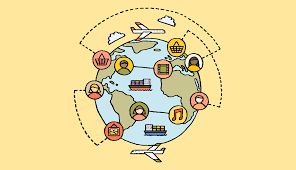
Globalization is often described as the shrinking of the world through increased interaction, integration, and interdependence. As the undisputed lingua franca of this era, English serves as the primary vehicle for international commerce, diplomacy, and digital communication. This shift has fundamentally altered the purpose of learning English; it is no longer just a window into the cultures of the United Kingdom or the United States, but a tool for global citizenship. Consequently, the content of English Language Teaching (ELT) textbooks has undergone a radical transformation, moving away from “native-speaker” centricity toward a model that reflects cultural diversity, functional pragmatism, and global social issues.
Historically, English textbooks were deeply rooted in the cultural landscapes of the “Inner Circle” countries—primarily Britain and America. Students in Tokyo or Cairo would read about London buses, afternoon tea, or Thanksgiving dinners. However, globalization has ushered in the era of English as an International Language (EIL). Modern textbooks now prioritize “Global Englishes,” acknowledging that a student is statistically more likely to use English to speak with another non-native speaker than with a Briton or an American. As a result, content has shifted toward neutral, international contexts. Instead of a dialogue between “John” and “Mary” in a New York café, a contemporary chapter might feature “Ananya” from India and “Hiroshi” from Japan discussing a business project via video call. This inclusive approach validates the learner’s own identity, signaling that they do not need to adopt a Western persona to be a successful English speaker.
Furthermore, globalization has demanded a shift from purely grammatical instruction to “communicative competence” tailored for a mobile workforce. In a globalized economy, English is a functional tool. Modern textbooks reflect this by focusing on transferable soft skills. Content often revolves around international business etiquette, digital literacy, and cross-cultural negotiation. For example, a unit might not just teach the present perfect tense but apply it within the context of writing a professional email to a multinational team or participating in a global seminar on sustainability. The “content” is increasingly dictated by the requirements of the global market, prioritizing clarity and efficiency over the nuances of regional idioms or literary prose.
Perhaps the most significant influence of globalization is the integration of “Global Issues” into the curriculum. As the world faces shared challenges, ELT publishers—many of whom are multinational corporations like Oxford University Press or Pearson—have aligned their content with universal values. Issues such as climate change, gender equality, human rights, and technological ethics are now standard topics. This serves a dual purpose: it provides cognitively engaging material for adult learners and prepares students to participate in the global discourse. By discussing the United Nations Sustainable Development Goals in an English lesson, the textbook transforms the language from a school subject into a medium for global activism and awareness.
However, the globalization of textbook content is not without its critics. The “McDonaldization” of ELT refers to the homogenization of content to make it “safe” for global markets. To ensure high sales across diverse regions—from the Middle East to South America—publishers often avoid “PARSNIP” topics (Politics, Alcohol, Religion, Sex, Narcotics, Isms, and Pork). While this makes textbooks globally marketable, some educators argue it results in “bland” or “sterile” content that avoids the real-world complexities of the very globalization it seeks to represent. When textbooks become too generic to avoid offending any culture, they may lose the authenticity required to truly engage a learner’s critical thinking skills.
In conclusion, globalization has acted as a powerful architect in the evolution of English language textbooks. It has dismantled the monopoly of Anglo-American culture, replacing it with a diverse, multi-polar view of the world. It has repurposed the language as a functional tool for the global economy and a platform for addressing international crises. While the pressure to create “one-size-fits-all” content can sometimes lead to cultural dilution, the overarching trend is one of empowerment. Modern textbooks reflect a world where English belongs to everyone who speaks it, providing learners with the linguistic and cultural tools to navigate a complex, interconnected planet.
The landscape of modern literacy has undergone a profound transformation. Traditional writing, once a solitary…
The shift toward digital learning has transformed how students acquire new languages. In the second…
For many language learners, poetry represents the intimidating summit of literature—a dense thicket of archaic…
The digital age has fundamentally altered how humanity communicates, connects, and shares information. At the…
Online learning is no longer a temporary alternative to the physical classroom. It is a…
The rise of digital learning has changed how people study across the world. In the…
