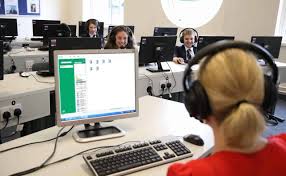
The rapid ascent of digital technology has sparked a high-stakes debate: is the traditional red-brick schoolhouse a relic of the past, or is it an irreplaceable cornerstone of human development? As virtual platforms become more sophisticated, some argue that online learning will inevitably “demolish” traditional schools. However, a closer look suggests that while the function of schools is being radically redesigned, their existence is protected by the unique social and psychological needs of the human learner.
The Digital Disruption: Efficiency and Access
The argument for the demolition of traditional schools often centers on the sheer efficiency of online learning. In a physical classroom, a single teacher must manage thirty students with varying speeds of comprehension. In contrast, online learning platforms utilize adaptive AI to tailor lessons to the individual. If a student masters a concept in five minutes, they move on; if they struggle, the system provides extra resources. This “personalized pacing” is nearly impossible to replicate at scale in a physical building.
Furthermore, online learning democratizes access. For a student in a rural village or a low-income urban area, the “traditional school” might be underfunded or physically inaccessible. Online platforms grant these students access to world-class curricula from institutions like MIT or Khan Academy. In this light, the traditional school building is seen as a physical barrier—a gatekeeper that restricts high-quality education to those who can afford to live near good districts.
The Infrastructure of Socialization
However, the “demolition” theory often overlooks the school’s role as a social incubator. Education is not merely the transmission of data from a screen to a brain; it is a social process. In a traditional school, students learn the “soft skills” that are essential for adult life: conflict resolution, teamwork, empathy, and the nuances of body language.
A Zoom window or a discussion board cannot replace the playground or the cafeteria. These unstructured environments are where children learn to navigate complex social hierarchies and build lifelong friendships. For younger children, especially, the school provides a sense of community and routine that is vital for emotional stability. Removing the physical school would essentially strip away the primary site of childhood socialization, leaving a void that digital avatars cannot fill.
The “Hidden” Functions of Physical Schools
Beyond academics and socialization, traditional schools serve critical societal functions that are often invisible until they are gone. For many families, schools act as a reliable childcare system that allows parents to participate in the workforce. During the COVID-19 pandemic, the world received a “trial run” of a school-less society. The result was not a digital utopia, but a massive economic and mental health crisis.
Schools also provide a safety net. For millions of children, the school is where they receive their most nutritious meal of the day, access mental health counseling, or find a safe haven from a turbulent home life. Teachers are often the first to notice signs of abuse or neglect. An algorithm can track a student’s math scores, but it cannot see the bruise on a child’s arm or the sadness in their eyes. Until society develops a different infrastructure to provide these social services, the physical school remains indispensable.
The Digital Divide and Inequality
If we were to replace physical schools with online learning, we would likely exacerbate the “Digital Divide.” While a wealthy student might have a private office, high-speed fiber internet, and a parent available for tutoring, a student from a disadvantaged background might be sharing a single smartphone with three siblings in a noisy room.
Traditional schools act as a “great equalizer.” Within the school walls, every student has access to the same desk, the same books, the same heating, and the same teacher. By moving education entirely online, we risk turning a public good into a private luxury, where the quality of one’s education is strictly dictated by the quality of one’s home environment.
The Future: Evolution, Not Demolition
Rather than demolition, we are witnessing an evolution. The future of education is likely “Hybrid” or “Blended.” In this model, the “knowledge transfer” (lectures and reading) happens online, while the physical school time is reserved for “active learning”—debates, lab experiments, collaborative projects, and sports.
The teacher’s role is shifting from a “sage on the stage” who delivers content to a “guide on the side” who facilitates critical thinking and emotional support. The school building will remain, but it will look less like a series of rows of desks and more like a community hub or a collaborative workspace.
Conclusion
Traditional schools will not be demolished by online learning because they provide something that technology cannot: human connection and a holistic social safety net. While online platforms are superior at delivering information and allowing for flexible pacing, they cannot replace the mentorship of a teacher or the shared experience of a classroom.
The digital revolution should be viewed as a powerful tool to enhance the physical school, not a wrecking ball intended to level it. We are moving toward a world where education is ubiquitous and digital, but where the school building remains the heart of the community—a place where we don’t just learn how to work, but how to live together.