The modern language classroom is no longer defined by rows of desks, static textbooks, and the monotonous drone of a lecture. As pedagogical approaches shift toward communicative competence, technology has become an essential enabler of active learning. Among these advancements, the smartboard—or interactive whiteboard—stands out as a powerful tool for transforming passive learning into an immersive, engaging, and highly communicative experience. Smartboards increase interaction among students in language classes by facilitating multisensory engagement, promoting collaborative learning, enhancing student-centered activities, and bridging geographical gaps, ultimately creating a dynamic environment where the target language is used authentically.
Multisensory Engagement and Psychological Safety
A foundational way smartboards increase interaction is by catering to diverse learning styles through multisensory engagement. Unlike traditional whiteboards, smartboards integrate visual, auditory, and kinesthetic elements into a single session. For language learners, this means that a grammar point can be presented not just through text, but through vibrant images, audio clips, interactive videos, and drag-and-drop activities.
This sensory-rich environment directly impacts student interaction by increasing attention and motivation. When learners are intrigued, they are more likely to participate. Moreover, smartboards enhance psychological safety, a critical factor in lowering the “affective filter” that often stops students from speaking a new language. The interactive, often game-like nature of the smartboard makes participation feel less like a test and more like a shared experience, encouraging even hesitant learners to stand up and contribute to the screen-based activities.
Fostering Collaboration and Peer-to-Peer Interaction
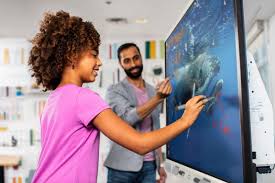
Smartboards transition the classroom focus from teacher-centered to student-centered learning. Many contemporary interactive displays support simultaneous multi-user interaction, allowing multiple students to touch, move, and write on the screen at the same time. This functionality is particularly useful for language practice, such as matching vocabulary words to pictures, rearranging mixed-up sentence structures, or collaborating on a group story.
When learners gather around the board, they are compelled to discuss, negotiate, and decide on answers together in the target language. For example, in a collaborative writing activity, students can brainstorming ideas, edit texts, and structure paragraphs directly on the screen, encouraging peer learning and immediate feedback. This shift from working in isolation to collaborative construction of meaning is a cornerstone of communicative language teaching, transforming the board into a shared hub of interaction.
Dynamic Gamification and Real-Time Interaction
Smartboards excel at implementing gamification, which inherently raises the energy level of the language classroom. Teachers can easily integrate games like bingo, Jeopardy-style quizzes, or word association games that encourage healthy competition and rapid, spontaneous language production.
In a language context, these games require students to recall vocabulary and grammar rules instantly, often under time pressure, which strengthens their communicative proficiency. When students interact physically with the board—dragging, flipping, or matching items—they are performing a kinesthetic action that reinforces learning. Furthermore, the immediate feedback provided by the software allows students to see errors and correct them immediately, fostering a dynamic of continuous improvement.
Facilitating Authentic Materials and Cultural Immersion
Interaction in language learning is not only about using vocabulary; it is about understanding the context and culture. Smartboards enable teachers to seamlessly bring the outside world into the classroom. Instead of just reading about a foreign city, students can use the smartboard to explore it via Google Earth, examine authentic newspaper articles, or watch videos of native speakers.
These authentic resources spark discussions and interaction. Students might be asked to interpret a video, compare the target culture with their own, or discuss a current news item they have just watched. The ability to annotate directly over these websites, highlighting key linguistic elements, allows for interactive, real-time analysis rather than a passive presentation.
Breaking Geographical and Social Barriers
In today’s globalized world, smartboards can bridge the gap between classrooms, even if they are thousands of miles apart. Through video conferencing integration, smartboards can connect students with native speakers for live language exchange programs, allowing them to practice speaking and listening skills in a natural setting.
This interaction goes beyond the classroom walls, enhancing students’ confidence and providing real-world purpose to their language learning efforts. Furthermore, for learners within the same classroom, the shared, public space of the board helps build community and rapport, making them more comfortable with one another.
Conclusion
Smartboards have revolutionized the language classroom, transforming it from a traditional, teacher-centered space into a vibrant, student-centered environment. By fostering multisensory engagement, encouraging collaboration, integrating gamification, and providing access to authentic materials, smartboards ensure that language learning is an interactive and enjoyable process.
However, it is important to note that the technology alone does not guarantee increased interaction. As researchers have highlighted, the effectiveness of smartboards depends heavily on the teacher’s ability to create well-planned, interactive lessons rather than simply using them as advanced projectors. When used effectively, however, smartboards are invaluable tools that not only increase interaction but also deepen understanding and foster a genuine passion for language acquisition.